
Will pharma consultancies still be worth buying in 20 years?
Highlights:
Pharma consulting M&A hit a record in 2025, with buyers paying a median 14.5x EBITDA and competing hard for high-quality specialist firms.
AI threatens one specific part of consulting — the assembly of information — while the judgement work that sits closest to a client’s decisions holds its value.
Regulatory pressure from the US IRA and EU HTA rules is making cross-functional advisory work non-discretionary, sustaining demand regardless of AI.
Pharma companies bringing AI in-house need more outside help to govern the technology and redesign how they operate around it.
The firms that will hold value over twenty years will be those shifting their weight towards judgement work.
The valuation of a pharma consultancy business is dependent on the judgement someone else makes about its future. Buyers aren’t paying for the work a business has already delivered, they’re paying for the work they believe it will win after the deal completes. Reputation and financial history help build a picture of the strengths of the business and how it’s likely to continue to perform, but ultimately, the decision on whether a business is worth acquiring hinges on one question: ‘Will clients still be paying for this kind of expertise in twenty years’ time?’
As AI becomes increasingly prevalent across professional services and consulting firms, every buyer is aware of its implementation — from models drafting strategy decks in minutes to chatbots running the analysis that used to occupy a whole team of junior consultants. As a result, major firms across the professional services industries are cutting back their graduate intake and reshaping their organisational structure to address changes to revenue per head models. Because of this, consultancies can start to look less like a durable asset for acquirers, and more like a business about to be automated out of its own margins. Because of this, consultancies can start to look less like a durable asset for acquirers, and more like a business about to be automated out of its own margins.
AI threatens a specific kind of consulting work: the assembly of information that once took teams of juniors weeks, and now takes just minutes. Judgement is different. Deciding what a company should do and getting an organisation to do it sits well beyond what an agentic model can offer. It requires specialist human ability to implement and oversee. Businesses that can demonstrate how much of their value rests on the services AI can’t replicate will be the ones who are still worth buying over the next twenty years.
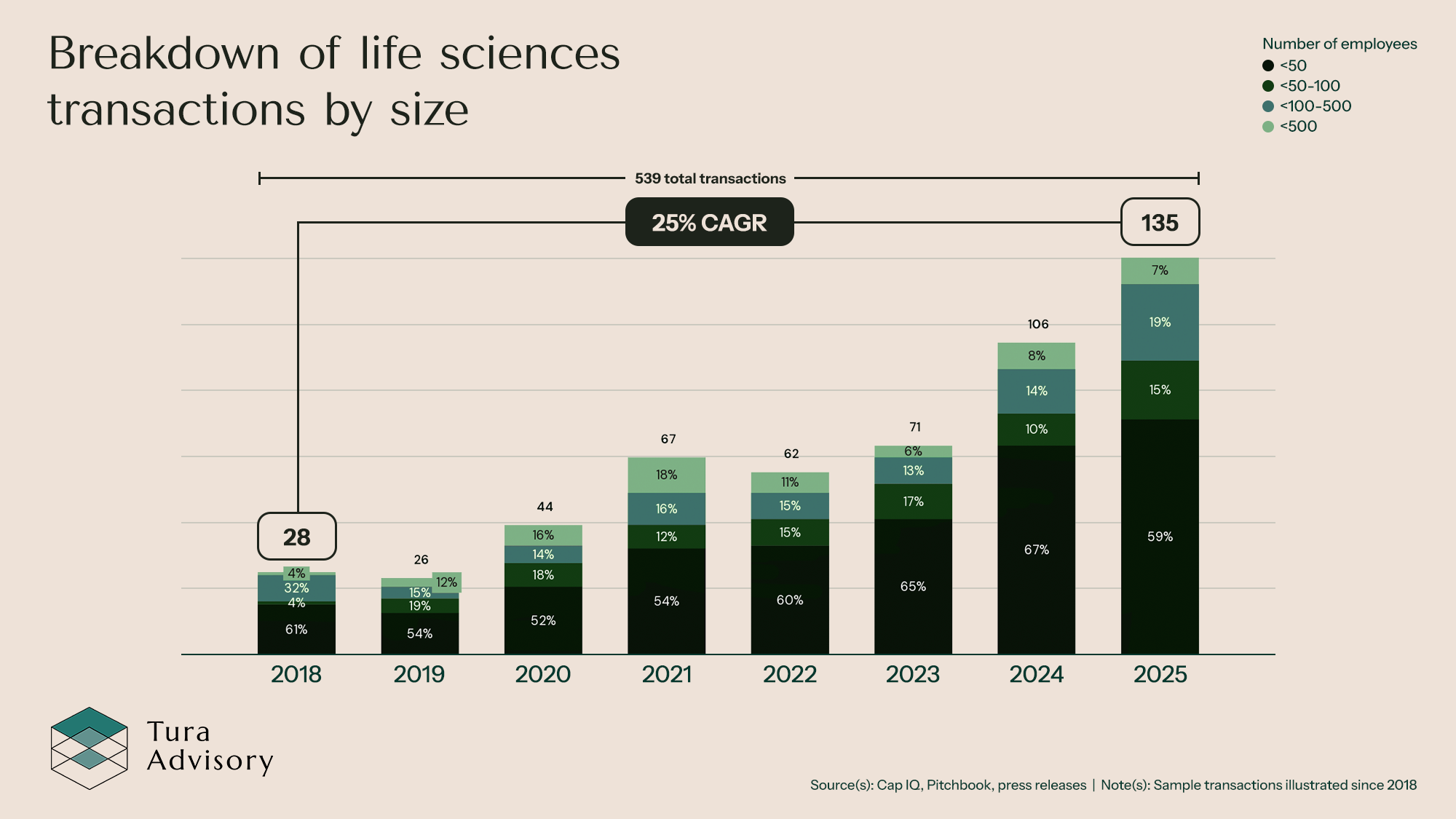
Pharma consulting M&A is at a record high
Whatever anxiety headlines create, the deal data tells a confident story for pharma consulting M&A. According to specialist M&A adviser Equiteq, 2025 was a record year for life sciences consulting transactions, with 135 completed deals - the highest since it began tracking the sector in 2018. Private equity-backed acquirers drove roughly three quarters of those transactions, and the global market for these services is growing at close to 9% a year through 2030.
Buyers are also paying well. Equiteq puts the median private-market valuation for the sector at 14.5x EBITDA, ahead of public-market comparables, with around 74% of firms acquired in 2025 employing fewer than 100 people. The scarcity of high-quality, mid-sized specialists is fuelling competition and pushing prices up, showing that this is a market competing hard for the right assets.
That strength though isn’t spread evenly. Equiteq’s data shows buyers paying up for scientific depth and for capability embedded in a client’s critical decisions - work that helps them win complex mandates. Firms that rely on routine delivery that clients can now get cheaply elsewhere, or handle in house, will command lower valuations.
Why judgement-led consulting holds its value
The work that commands those higher valuations is difficult to automate for a simple reason — it isn’t just information assembly. It’s judgement applied to a specific organisation’s problem, working out what a company should do given its portfolio, its capabilities and its internal politics, then getting a group of people who don’t naturally agree to commit to a single plan. It means redesigning how a commercial or medical function operates once a new technology or regulatory reality lands, and staying involved long enough to make sure the plan survives contact with the organisation in question.
AI doesn’t shrink the market for that specialised expertise. If anything, it widens it, because every new tool a pharma company adopts creates fresh questions about how to use it, who owns it, and how it changes the way the organisation runs. The value sits in work that’s hard to replicate and well away from the output a model can generate.
That work also recurs. A pharma company doesn’t redesign its operating model once and move on. It does so again with every meaningful shift in the sciences, technology, or the regulation beneath it, which over twenty years amounts to a series of engagements rather than just one. That recurring demand is what turns a client relationship into predictable, repeatable revenue, which is exactly what a buyer will pay a premium for.

The regulatory complexity keeping demand non-discretionary
There is a second reason to expect demand to hold, and it has nothing to do with AI. The difficulty of getting medicine to patients and being paid fairly for it isn’t easing.
Much of the sector’s future work is non-discretionary: mandatory, multi-year change programmes that clients can’t postpone, whatever their budget pressures. Negotiated prices under the US Inflation Reduction Act expand from 2026. New EU Health Technology Assessment rules also bring joint clinical assessments into force. Evidence, pricing and access decisions are compressing across major markets at the same time. This is the cross-functional, high-stakes work a judgement-led firm exists to do, and it’s getting harder. Better tools don’t dissolve that complexity. They raise the stakes, because they make it cheaper to move quickly in the wrong direction.
Why in-housing AI increases the need for advisers
A pharma company building its own AI capability doesn’t stop needing outside help. It needs a different kind of help. Designing the operating model around a new tool, running the productivity programme that follows, and building the governance, validation and compliance frameworks a regulated business requires are all work that surfaces once a company owns the technology and then has to make it function safely. Owning the capability is not the same as knowing how to deploy it well.
The consulting firms that will do best over the coming decades will be those helping clients build and govern their own capability, rather than selling that capability as a deliverable a client could produce for itself.

What separates a resilient pharma consultancy from a vulnerable one?
The pharma consulting market is not being automated out of existence. Buyers are active and paying strong multiples, but they are paying for judgement — for the advisory work that sits closest to a client’s hardest decisions — not for the output a model can now generate in minutes.
For a founder, that turns a twenty-year question into a present-day one. The firms that will still command a premium in two decades are the ones who are already shifting their weight towards the work AI can’t replicate, and away from the delivery it can. That shift may take several years, which makes it worth starting well before a sale is ever on the table.
For a confidential discussion about what your pharma consulting business could be worth in a changing market, speak to the Tura Advisory team.
