
What Founders Can Learn From How PE Prepares For Sale
Highlights:
There are around 16,000 PE-backed businesses waiting to exit, and holding periods have reached a historic average of 6.6 years. In this market, preparation has never mattered more.
PE firms treat exit preparation as a multi-year discipline starting at acquisition. The practices behind that are largely the same ones a good M&A advisor brings to founders.
PE exit preparation follows a maturity ladder. Most founders are stronger on the lower rungs than the higher ones, and understanding where you sit is the first step to moving up.
There’s a record backlog of PE-owned businesses waiting to exit. Around 16,000 private equity-backed businesses are currently sitting in portfolios around the world, while holding periods have reached an historic average of 6.6 years. When the queue to sell is that long, buyers can afford to be selective, and they are. Because of this, preparation matters more than ever when planning an exit.
Private equity (PE) firms treat exit preparation as a discipline. The work starts at acquisition and runs through the entire hold period. By the time an asset goes to market, it has been shaped, refined, and positioned by people whose job, for years, has been to make sure the exit goes well. The actions PE firms take to prepare assets for sale is, in most respects, the same way a good M&A advisor will guide founders to ready their business for exit. Tura’s Managing Director, Bruce Green, said: “A PE fund’s success is not just in buying the right companies, it is also about achieving the best exit. PE therefore treat exit prep as a multi-year discipline, keeping management accountable throughout the hold period. Founders can learn a lot from understanding some of the principles that PE apply to exit prep.”
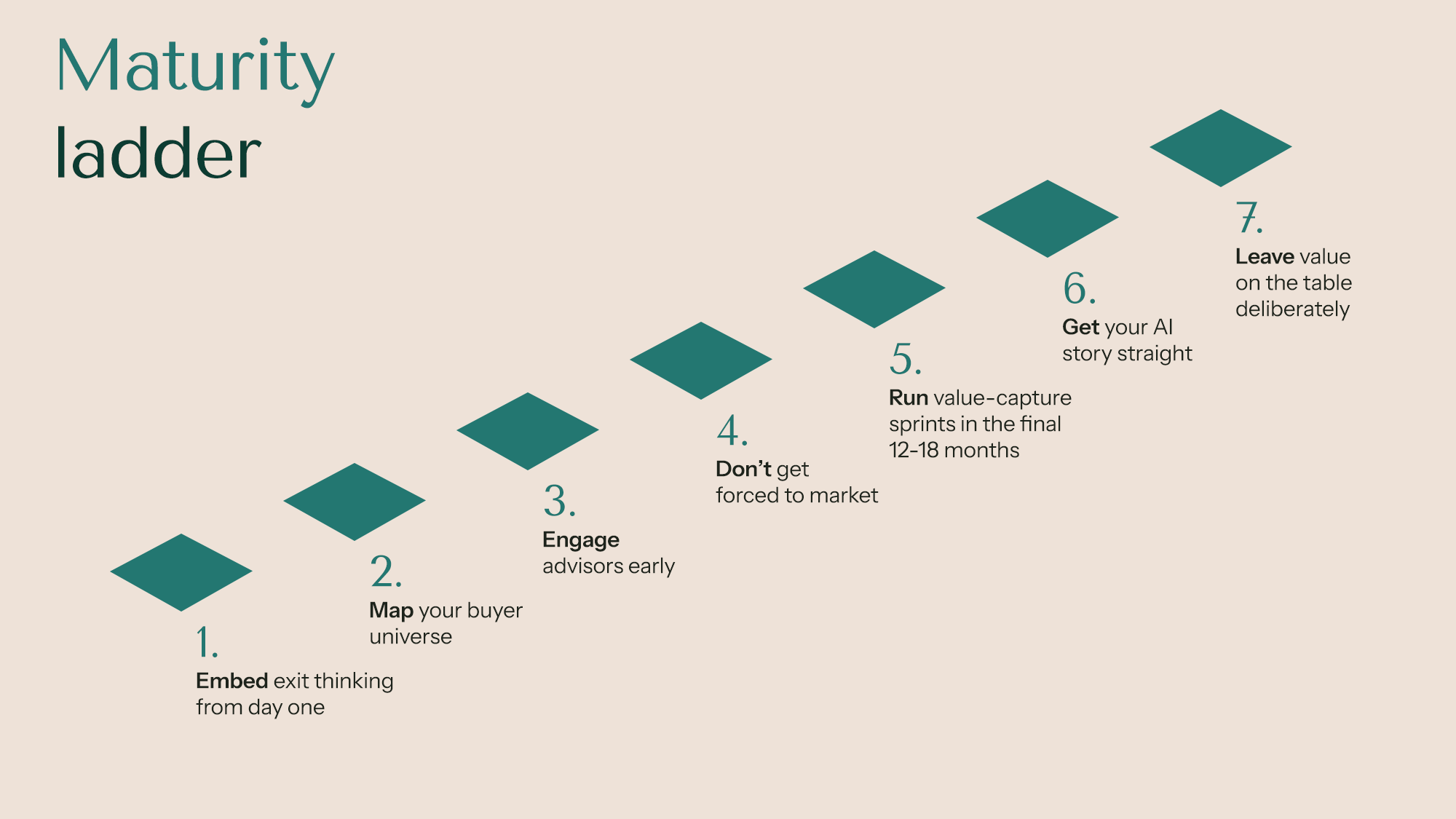
The businesses that secure the strongest outcomes have been prepared with the same rigour and discipline that PE firms apply to every asset they sell, and the practices behind that preparation form a maturity ladder. The points that follow each represent a rung of that ladder. Understanding where a business sits on that ladder is a measure of how prepared it is for sale, while progressing up it is how founders strengthen their position before they go to market.
1. Embed exit thinking from day one
The starting point for PE exit preparation is also the one a lot of founders push back on, because it asks them to think about selling at a point when selling is the last thing on their mind.
At Tura’s Building To Exit panel event earlier this year, Dan Egerton, CEO of Actus Consulting, said: “A business that's built for sale is a better business. It doesn’t mean you have to sell it, but it’s a better business.”
PE firms embed this exit thinking from the moment they acquire a business. They run the business now, the way a buyer will assess it later. That means clean, auditable data, contracts that will hold up under scrutiny, and reporting that answers the key questions a buyer will have at any one time. None of this requires a founder to be actively thinking about a sale, but it makes the business more straightforward to assess when the time comes.
2. Map your buyer universe
Knowing who is likely to buy the business, whether that be trade or PE, and developing that picture years before any process begins is equally foundational for preparing to exit.
PE firms maintain running lists of likely acquirers from early in the hold period, distinguishing between trade buyers and financial sponsors, and tracking how each type values the asset differently. A corporate acquirer looking for capability or market access is making a different calculation to a financial sponsor looking for a platform with headroom to grow. A business that thinks about who is realistically going to buy, and shapes the business to what those buyers value from an early stage, is likely to become a much more enticing acquisition at the time of exit.
3. Engage advisors early
The prep that wins on the sell-side isn’t improvised in the final months of a process. PE firms use advisors throughout the hold period, not to run a transaction, but to shape the equity story, stress-test the plan, and ensure the business is being positioned in ways that will land with buyers. By the time the sale process begins, the relationship is already operational and the advisor knows the business, the buyer landscape, and has already been contributing to how the asset is being prepared. That is a meaningfully different starting position to bringing someone in when a deal is already in motion.
M&A advisors are active in the market, speaking to other investors and acquirers. They can help you keep track of the market and identify the most likely buyers, helping you to understand what they’re looking for. This isn’t to say that you need to engage them formally or enter into a contract at this early stage. Most advisors will be happy to share intel as they build a relationship.

4. Don’t get forced to market
Involuntary sellers almost always achieve the worst outcomes. Businesses sold under pressure, whether because a founder is burned out, because a key person has left, or because the business has hit a period of difficulty, consistently achieve lower multiples than businesses sold from a position of stability and choice.
PE firms implement governance structures designed to prevent forced sales which include clear goals (typically manifesting as specific financial metrics), explicit timing benchmarks, sequenced sale processes, and enough optionality to avoid being compelled to sell into conditions they wouldn’t choose. Buyers are experienced at reading urgency, and they price for it. The right time to begin thinking seriously about exit preparation is before any pressure to sell exists. The more you can govern, the stronger outcome you’re likely to achieve.
5. Run value-capture sprints in the final 12-18 months
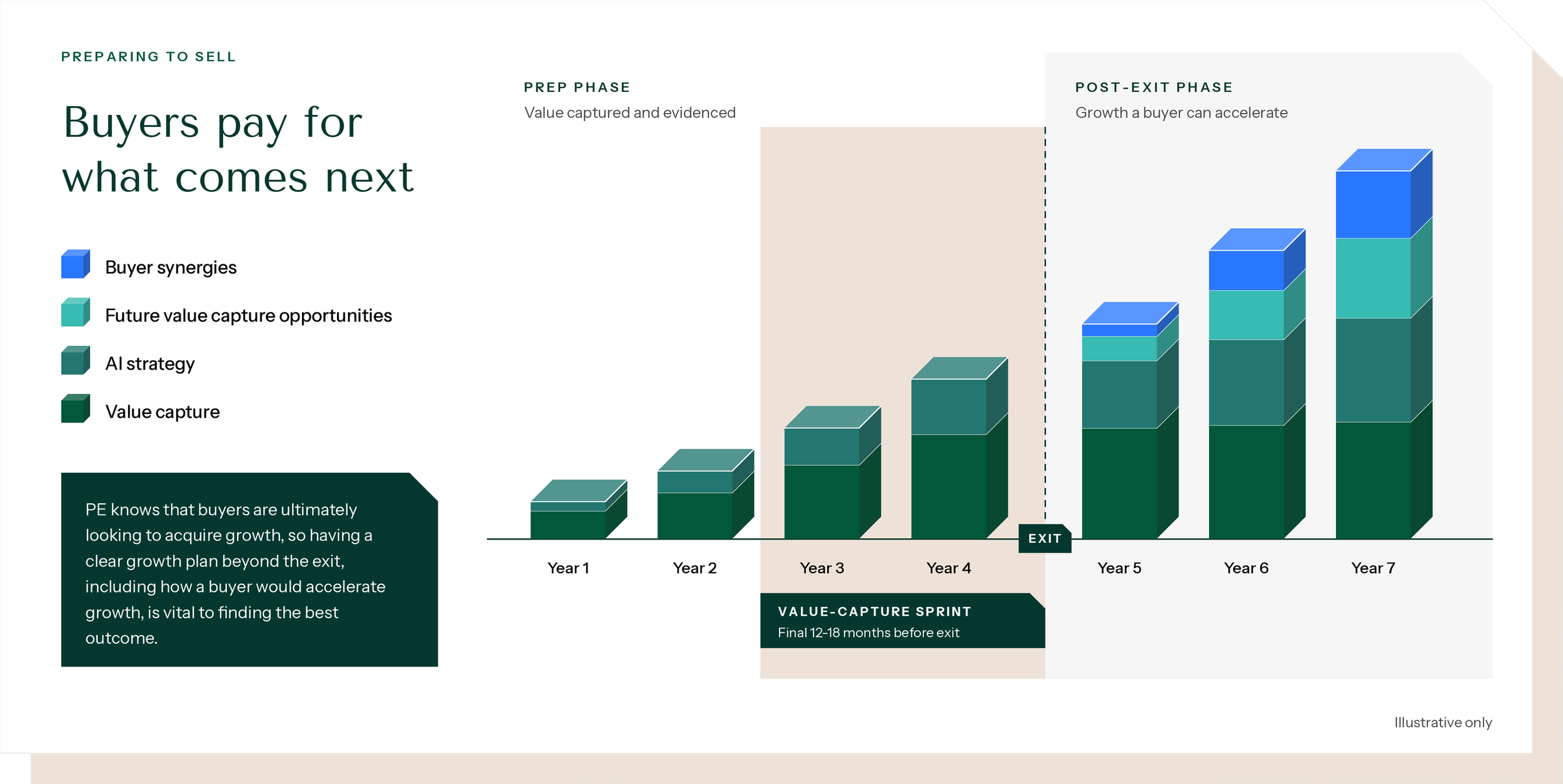
Momentum matters as much as position. In the 12 to 18 months before a planned sale, PE firms accelerate a targeted set of initiatives designed to build visible progress in the metrics buyers will scrutinise: pricing, cost efficiency, recurring revenue, margin. The aim isn’t to transform the business, but to demonstrate a clear trajectory in the data that will be available during diligence.
Structural improvements take time to show up in numbers. Initiatives launched 12 to 18 months before exit have had time to land and can be evidenced clearly. The same initiatives launched six months out are often too recent to carry weight without a strong story attached to them. Buyers will assess trajectory as well as position, and trajectory needs time to establish itself.
6. Get your AI story straight
AI readiness has moved up the diligence agenda fast. Buyers now routinely assess it as part of their evaluation process as a structured question about strategy, infrastructure, and what is live in the business. Pilot-mode experimentation that hasn’t moved beyond proof of concept, roadmaps with no grounding in commercial outcomes, and AI strategies that exist in a presentation as opposed to being operational in the business are all visible to an experienced diligence team.
In tech services, where buyers reasonably expect a tech-focused business to have thought carefully about how AI affects its own operations, a clear and evidenced position is no longer optional.
7. Leave value on the table deliberately
This is the practice that tends to surprise founders most, and the one most worth spending time on.
In the final stages of preparing an asset for sale, sophisticated PE sellers don’t attempt to capture every available source of value before going to market. They deliberately leave a portion of identifiable value uncaptured, then surface it explicitly in vendor due diligence as the next phase of a programme that has already demonstrated results in the first phase.
A buyer acquiring a business that has been fully optimised is acquiring something with limited visible upside, whereas a buyer acquiring a business with a credible, mapped runway of uncaptured opportunity is acquiring something with demonstrable growth potential, which will be reflected in the price they pay. A visible growth runway can be worth more than a maxed-out business with nowhere left to go.
Most founders will have the opposite instinct. Resolve every issue, fix every weakness, and present the business in its most complete and polished state. That instinct is understandable, but it can work against the outcome. A business that still has visible, credible headroom is often a more attractive acquisition than one that has used it all up.
Climbing the ladder
The seven practices above aren’t secrets. They’re what experienced M&A advisors bring to founder-led businesses every day, drawn from the same professional discipline that PE firms have refined.
Most founders are strong at the lower end of the ladder, but when it comes to the higher rungs where the work gets harder and the instincts are more likely to need challenging, they often falter. That’s when an experienced advisor makes the difference. In a market where thousands of businesses are competing for buyer attention, the ones that stand out are those that have been prepared with the same rigour PE applies to every asset it sells.
Whether you are planning ahead or beginning to explore your options, Tura Advisory will guide you through with clear, strategic advice and complete confidentiality. Schedule a consultation here.
7. Leave value on the table deliberately
This is the practice that tends to surprise founders most, and the one most worth spending time on.
In the final stages of preparing an asset for sale, sophisticated PE sellers don’t attempt to capture every available source of value before going to market. They deliberately leave a portion of identifiable value uncaptured, then surface it explicitly in vendor due diligence as the next phase of a programme that has already demonstrated results in the first phase.
A buyer acquiring a business that has been fully optimised is acquiring something with limited visible upside, whereas a buyer acquiring a business with a credible, mapped runway of uncaptured opportunity is acquiring something with demonstrable growth potential, which will be reflected in the price they pay. A visible growth runway can be worth more than a maxed-out business with nowhere left to go.
Most founders will have the opposite instinct. Resolve every issue, fix every weakness, and present the business in its most complete and polished state. That instinct is understandable, but it can work against the outcome. A business that still has visible, credible headroom is often a more attractive acquisition than one that has used it all up.
Climbing the ladder
The seven practices above aren’t secrets. They’re what experienced M&A advisors bring to founder-led businesses every day, drawn from the same professional discipline that PE firms have refined.
Most founders are strong at the lower end of the ladder, but when it comes to the higher rungs where the work gets harder and the instincts are more likely to need challenging, they often falter. That’s when an experienced advisor makes the difference. In a market where thousands of businesses are competing for buyer attention, the ones that stand out are those that have been prepared with the same rigour PE applies to every asset it sells.
Whether you are planning ahead or beginning to explore your options, Tura Advisory will guide you through with clear, strategic advice and complete confidentiality. Schedule a consultation here.
