
Revenue Per Head: The AI-Era Metric Tech Services Buyers Are Watching
Highlights:
Revenue Per Head (RPH) has always been a telling metric for buyers when assessing tech services acquisitions.
AI is decoupling revenue from headcount, giving RPH even more weight as a signal of margin and multiple.
Growing revenue by growing headcount no longer signals health. Flat RPH now reads as a warning.
Two businesses with identical revenue can sit on opposite valuation trajectories, depending on which way their headcount is moving.
Revenue Per Head (RPH) has always been a telling metric for buyers when assessing where target acquisitions sit in the tech services value chain, speaking directly to a business’s pricing effectiveness and delivery efficiency. Thanks to AI, RPH now carries more weight when assessing value, since revenue on its own is a less reliable signal than it used to be.
AI has disrupted the relationship between revenue and headcount, which used to provide a fixed growth model. As headcount would rise, so would revenue, but AI-driven efficiency means that tech services businesses can now, for the first time, generate more revenue with lower headcounts.
RPH is now the cleanest proxy for that AI-driven efficiency, and it maps directly to margin and multiple. A business generating the same revenue with fewer people carries a lower cost base, which lifts margin directly. Buyers typically apply a multiple to EBITDA, so a margin improvement driven by fewer heads flows straight into EBITDA without revenue needing to move at all, which allows an RPH improvement to re-rate a business independently of its growth story.
AI is breaking the old growth model
For as long as most tech services firms have been operating, adding revenue by adding people was the definition of a healthy business. A team grows in step with its client base, and the additional headcount cost that comes with it is accepted as simply the price of scaling, because there was no other realistic way to deliver more work without more people to do it. Under this model, flat RPH meant a business was scaling in the way scaling was always supposed to look.
When AI-driven efficiency is available to a business, growing headcount in step with revenue is no longer the only way to deliver more work. This means that a business that continues adding people at the old rate is absorbing costs it no longer needs to absorb.
Tura's Managing Director, Bruce Green, says: "AI doesn't change what you sell, it changes how many people you need to sell it."
The largest players in tech services already show this in practice: platforms such as Accenture's GenWizard and Cognizant's Flowsource are built directly into how work gets delivered, embedding AI into the delivery pipeline itself rather than adding it as an extra tool for an unchanged team to use.
RPH, which used to hold roughly flat under the old growth pattern, is where headcount inefficiency now shows up first. Buyers are increasingly reading a flat RPH figure as a sign a business hasn't adapted, rather than as a neutral consequence of growth. Flat RPH is now a warning, not a success.
Mapping the shift
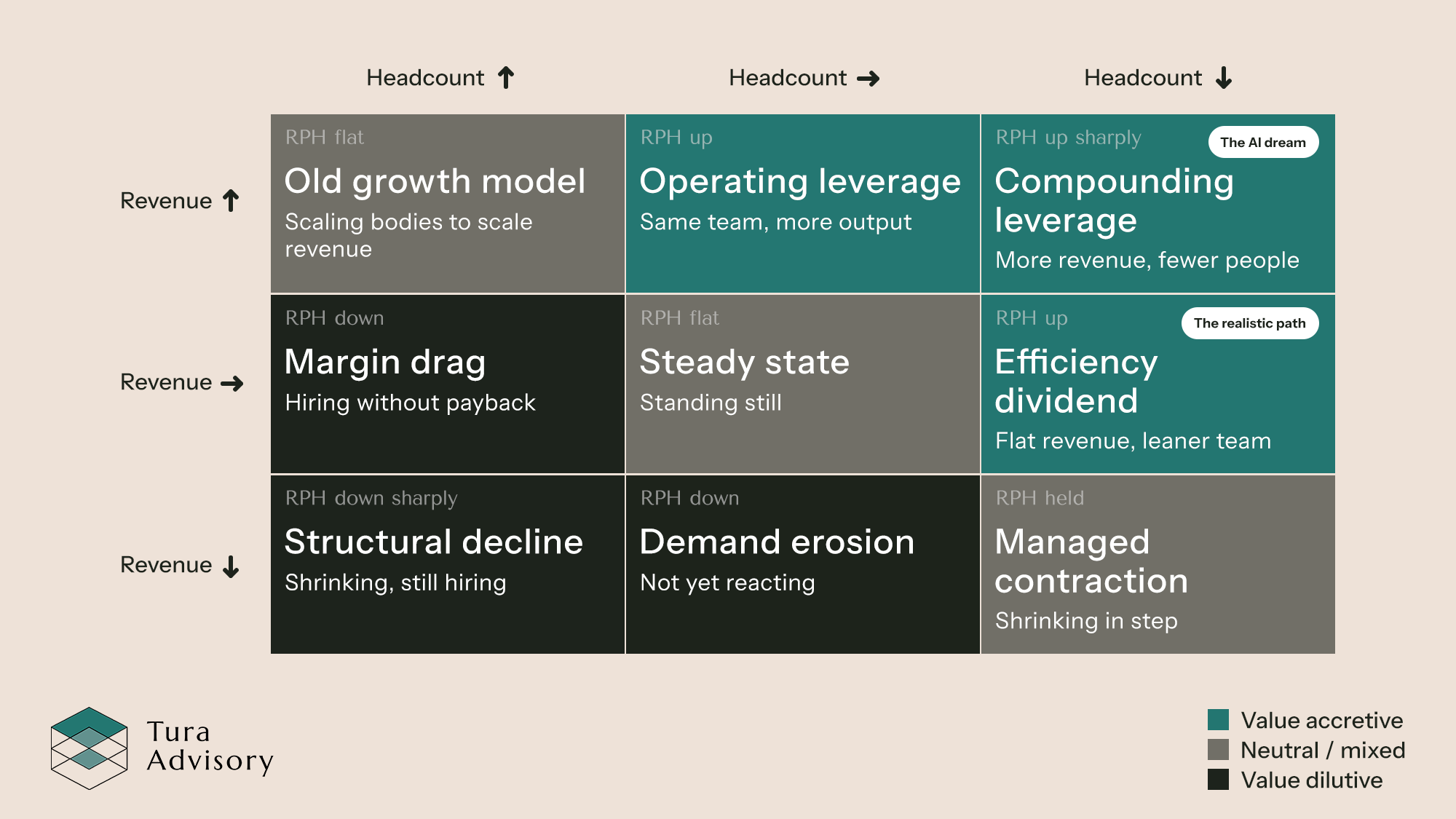
The matrix below sets revenue direction against headcount direction, and each combination produces a different RPH outcome. Placing a business on it shows a buyer, in one view, whether that business is moving toward a stronger position or a weaker one.
The old model
Revenue rising because headcount rises alongside it sits in the upper left of the matrix. RPH stays flat there, the old pattern still running. Under the old model, this looked like healthy growth, but no longer does. The flat RPH it produces is the same flat RPH a buyer now reads as a business that hasn't engaged with AI-driven efficiency at all.
The strongest position
In the upper right of the matrix, revenue rises while headcount falls, and RPH rises sharply as a result. This is the strongest position a business can reach, and every founder would choose it if it were simply available on demand. It usually isn't the likely near-term outcome for most firms, because AI tends to put pressure on the revenue figure before its efficiency gains are proven out to clients, who typically expect some share of the efficiency gain reflected in what they pay.
The realistic path
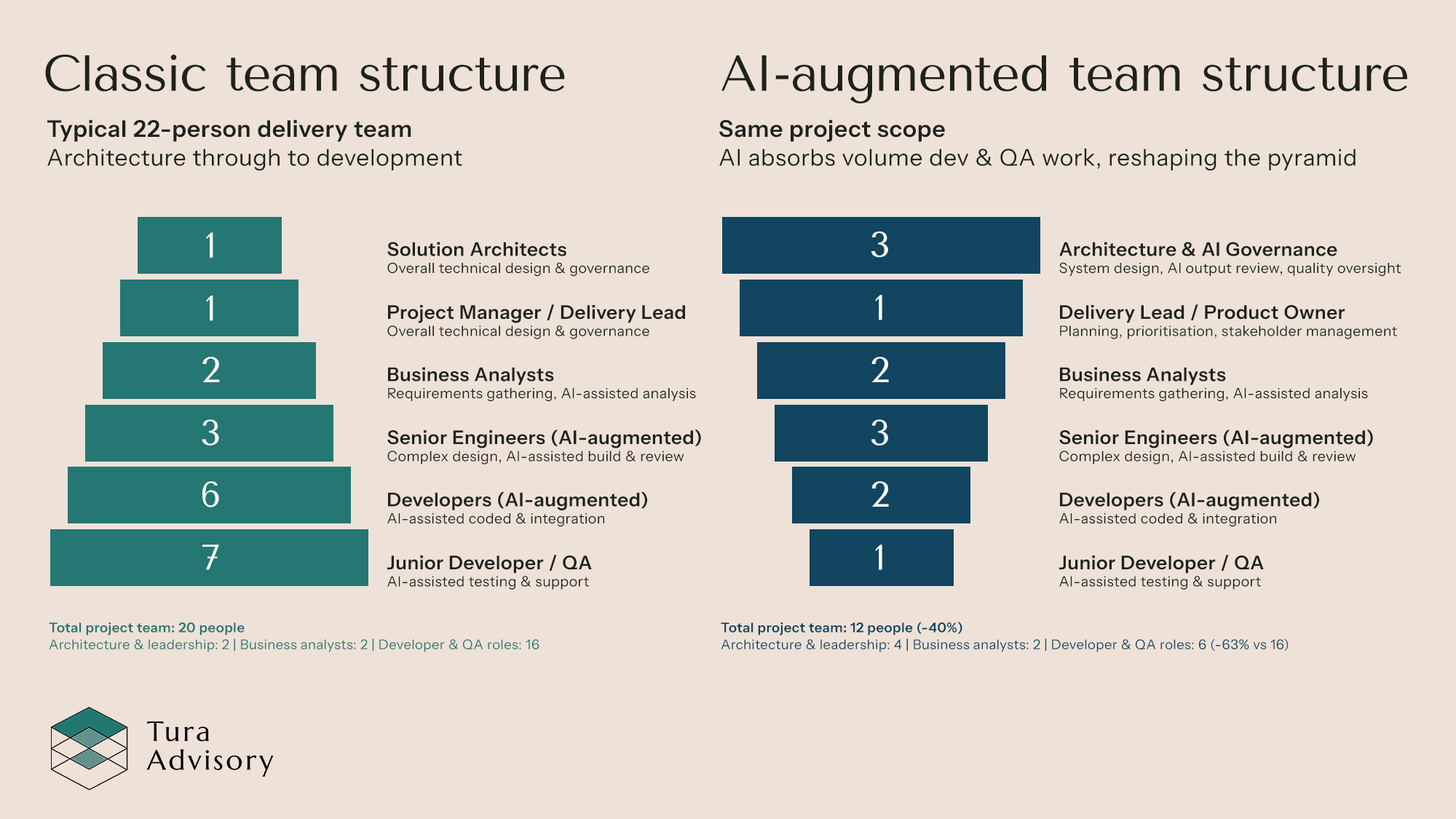
Directly below the strongest position sits the more realistic near-term outcome: revenue holds broadly flat, and AI efficiencies let a business deliver this with fewer people. A typical IT services delivery team illustrates what this looks like in practice. A classic 20-person team is structured across six tiers:
One solution architect
One project manager or delivery lead
Two business analysts
Three senior developers or tech leads
Six developers
Seven junior developers or QA analysts
Shaped out, this is a classic pyramid, weighted heavily at the base in junior execution roles, narrowing steadily toward a single architect at the top.
Under an AI-augmented model delivering the same scope of work, that team compresses to 12:
Architecture and AI governance grows to three people,
The delivery lead role remains
Business analyst headcount holds at two
Senior engineers working with AI assistance number three
Developers fall to two
Junior developer or QA support falls to one
The shape changes along with the size. The base of junior execution roles all but disappears, while architecture, governance and senior delivery roles now make up the bulk of the team. What was a pyramid, weighted at the bottom, becomes closer to a diamond, weighted through the middle and senior layers rather than the base.
The compression sits almost entirely in execution-level roles. Developer and QA headcount falls from 16 to 6, a reduction of around 63%, while architecture and leadership roles grow from two to four. Revenue does not need to move for that shift in team shape to lift RPH. It still improves margin, and it still re-rates the business without the need for a demand story it doesn't have, which matters because buyers currently apply real caution to growth projections that rest on efficiency gains not yet proven with clients.
Same revenue, different trajectory
Two firms with identical revenue can be on opposite valuation trajectories, depending on where their headcount is going.
Take a hypothetical example: two businesses each generating £10m in revenue this year. One has grown its headcount from 60 to 75 over the past two years to sustain that figure, sitting in the upper left of the matrix. The other has held revenue flat while reducing headcount from 70 to 55 through AI-driven efficiency, sitting in the realistic-path quadrant. Both report the same £10m top line, but the first now sits at roughly £133,000 RPH while the second has risen to around £182,000. A buyer pricing on RPH would value these two businesses very differently, despite identical revenue.
The danger zone
The bottom left of the matrix is where the real risk sits: revenue falling while headcount keeps rising signals structural decline.
To illustrate - a hypothetical business generating £8m in revenue two years ago from a team of 50 (roughly £160,000 RPH) sees revenue fall to £6.5m while headcount rises to 58 to cover delivery gaps. RPH on that business drops to roughly £112,000, a fall of nearly 30% in two years, moving in the wrong direction on both variables at once.
Buyers assessing a business in this position are likely to apply a lower multiple to reflect the direction rather than the current figure, and will scrutinise the reasons behind rising headcount closely during due diligence.

Positioning RPH for exit
The valuation multiple is set by direction, as much as it is by where a business is today. This means that founders who are looking to make a sale in the next 12-24 months have time to set the business on the right RPH trajectory.
On current mid-market conventions, that trajectory is worth roughly £200,000 to £500,000 per head in valuation terms, the range a buyer is effectively pricing when they look at where a business's RPH is heading rather than where it started.
Moving that trajectory isn’t necessarily a matter of headcount reduction alone. It tends to come from changes to the shape of the delivery team: fewer junior execution roles, a larger share of senior and specialist roles, and workflows redesigned around what AI now handles rather than AI added on top of an unchanged structure.
Demonstrating this movement to a buyer requires more than a single data point. A trend across several reporting periods, tied to specific, identifiable changes in team structure rather than a one-off headcount reduction ahead of a sale, is what gives a buyer confidence that the direction is structural rather than temporary.
Revenue tells a buyer what a business made last year. RPH, and the direction it's moving in, tells a buyer what it's likely to be worth next.
If you're weighing where your business sits on this matrix, and what it would take to shift its trajectory before you bring it to market, Tura's sector specialists can help you think it through. Get in touch to talk through your position.
