
IBM’s Worst Day On Record: The Public Market Impact on IT Services
Highlights:
IBM's worst trading day since records began in 1968 has reinforced a fear that has been building in public markets: that AI is crowding out traditional IT budgets.
Listed IT services equities have de-rated 20-50% over the past 12 months. Sophisticated buyers will use those compressed multiples as an anchor in private negotiations.
The businesses being repriced are large, headcount-heavy models dependent on discretionary enterprise spend. That is not a description of the mid-market.
Private market appetite for well-run, AI-enabled services businesses has not weakened. Valuations are diverging, not collapsing.
AI-readiness is now a diligence question and businesses that can demonstrate it through their own commercial performance are commanding premiums.
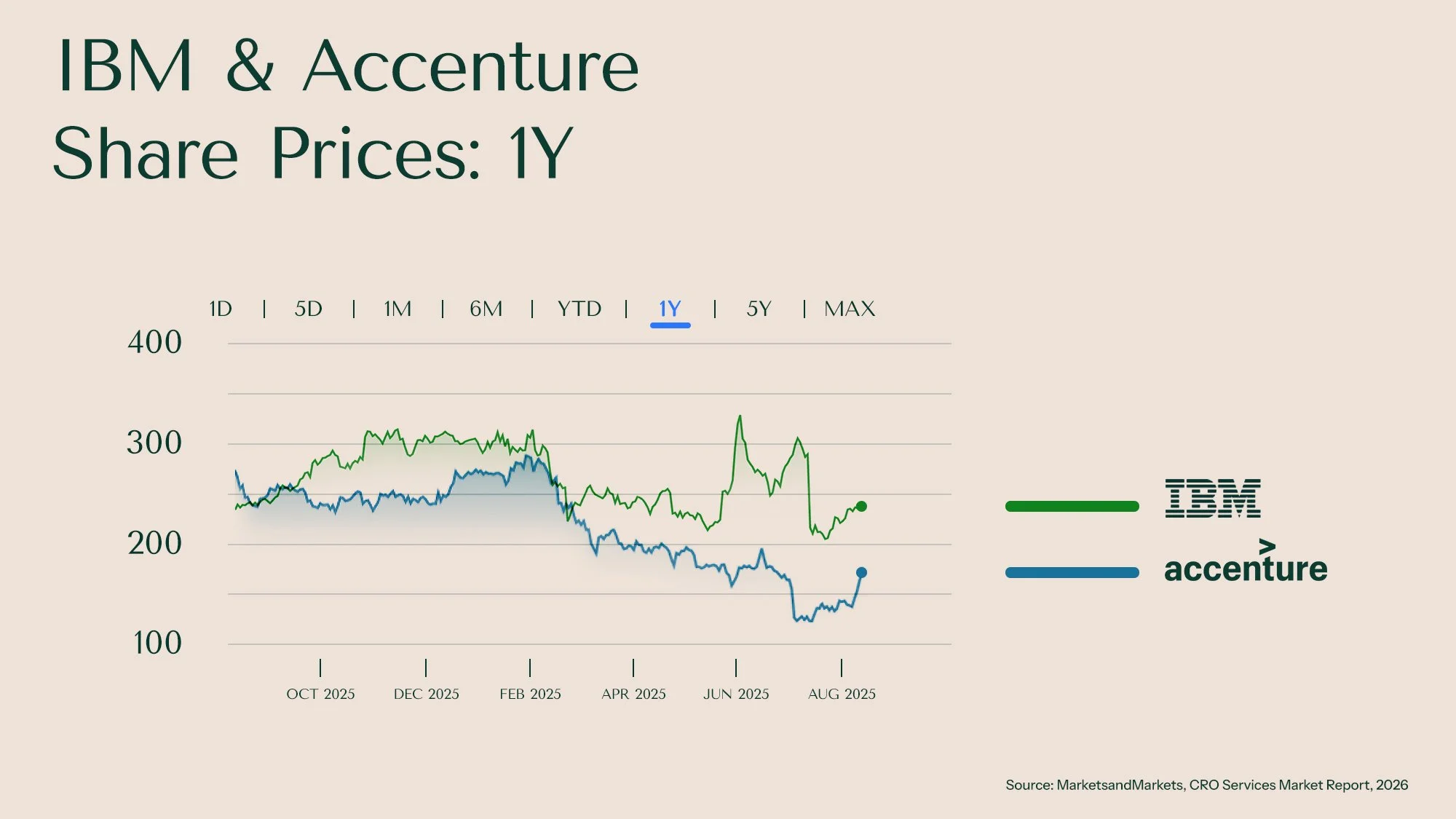
On 14 July, IBM released preliminary second-quarter results that sent its share price down 25% in a single session. This became its worst trading day since records began in 1968, with around $68 billion in market value erased before the close. The trigger was a revenue miss of roughly $660 million against analyst expectations, driven by enterprise clients shifting capital expenditure away from software and consulting and towards AI infrastructure in the final weeks of the quarter. Chief executive Arvind Krishna explained: "In the last few weeks of June, we saw clients shift their quarterly capex spend toward servers, storage, and memory purchases to secure supply-constrained infrastructure ahead of expected price increases. This dynamic impacted client buying patterns."
It was not an isolated event. Accenture had already recorded its own worst day on record in June, falling nearly 18% after cutting its full-year revenue growth guidance from 3–5% to 3–4% and reporting a 2% decline in new bookings. The stock opened 2026 at approximately $259. It now trades around $125 - a decline of more than 50% year-to-date.
The two data points have reinforced a fear that has been building in public markets for months: AI is beginning to crowd out traditional IT budgets, and the billable-hour model underpinning the giants of listed IT services is under structural threat.
But public markets are telling only part of the story. While listed IT services names are being aggressively repriced on AI fears, private buyers - particularly software-native private equity - are paying premium multiples for the right mid-market services businesses. Valuations are diverging, not collapsing, as public and private markets reach different conclusions about what AI means for tech services valuations.
Expect buyers to use public market repricing as an anchor
IBM lowered its full-year revenue growth forecast to between 4–5% on 22 July, down from previous expectations of more than 5%, with the new midpoint sitting below analyst consensus. In doing so, the company signalled to the market that the client budget shifts described are not expected to be a temporary disruption and that they reflect a structural change in how enterprise clients are allocating technology spend. Listed IT services equities have de-rated 20-50% across some of the largest players in the past 12 months. This includes Accenture, Tata Consultancy Services (TCS), Infosys, Cognizant, Wipro, Capgemini and CGI. That forward-looking context means the repricing is unlikely to reverse quickly.
When public market valuations fall, buyers quickly start applying those lower benchmarks to private sale negotiations, often before properly considering whether the comparison is actually valid. A trade acquirer or software-native PE firm will anchor to what listed businesses are trading at and apply pressure from there. At least, they will use it as a signal to justify a drag on pricing.
The counter-argument is that the businesses driving the public market repricing are specific in their characteristics, and crucially, that the de-rating reflects investor concerns around AI replaceability risk, not weakening structural demand. That specificity matters enormously when a valuation is being set.
This is a repricing of scale, not a sector verdict
IBM's full Q2 results show where damage concentrated. The mainframe division fell 42%, dragging overall growth down by more than five percentage points against IBM's own prior expectations. This isn’t a problem isolated to IBM. Accenture, which runs more than 700,000 people billing hours on large discretionary transformation programmes, has seen its stock fall more than 50% year-to-date as markets reach the same conclusion about its model. The businesses under pressure are large, headcount-heavy, and deeply dependent on the enterprise discretionary spend that AI is crowding out.
The parts of IBM's portfolio that grew in Q2 tell a different story. Red Hat was up 11%. Distributed Infrastructure was up 37%, with Power and Storage growing at record pace and an order backlog of nearly $500 million now built up behind them. The watsonx AI portfolio, HashiCorp and Confluent also delivered strong performance. These are the software businesses helping clients manage, deploy and build AI-ready solutions. The divergence within IBM's own numbers sits between the legacy divisions and those with genuine AI exposure. The growth maps directly to the businesses where enterprise AI spend is accelerating, while the businesses that are dependent on the discretionary budgets that AI spend is displacing are in decline.
A specialist tech/IT services business, whether MSP or consulting, with high recurring revenue, strong client retention, and genuine vertical depth is a fundamentally different asset to the businesses being repriced. It doesn’t carry the same AI substitution risk and isn’t dependent on the same discretionary enterprise budgets, which means the public sell-off is a verdict on a model, not a verdict on the sector.

Private markets are moving in the opposite direction
The public sell-off hasn’t dampened private market appetite for the right businesses. If anything, it has accelerated a shift that has been building since the SaaSpocalypse began, redirecting enterprise budgets away from traditional software and services. Software-native investors have spent the last eighteen months building theses around AI-enabled services businesses with outcome-based pricing, high recurring revenue, and technical capability that AI amplifies rather than displaces. As we noted earlier this year when Anthropic and OpenAI both launched PE-backed services ventures, a new and well-capitalised class of buyer has entered the market with a clear view of what it wants. That view has not changed.
Valuations aren’t collapsing, they’re diverging. Private valuations for well-run, AI-enabled, recurring-revenue businesses are holding - and in the right processes, strengthening - while listed multiples fall. A business anchored to public comparables that it does not resemble leaves value on the table. A business that can demonstrate clearly why those comparables do not apply is in a position to use the current dislocation to its advantage.
IBM’s results reflect a shift already underway
IBM's Q2 results add further weight to a dynamic private buyers are already acting on. AI-readiness is already determining which businesses grow and which decline, and the divergence within IBM's own portfolio between legacy divisions and AI-adjacent businesses makes that visible at a scale that’s hard to ignore. IBM's CEO attributed the consulting and software slowdown to clients redirecting budget towards AI infrastructure. That budget is not disappearing; it is moving, and private buyers want evidence that the businesses they are acquiring are positioned to capture it rather than lose it.
Businesses that can demonstrate AI is expanding their margins, compressing delivery cycles, or enabling outcome-based pricing are attracting a different quality of buyer conversation. Those that cannot are increasingly exposed to a market in which the public sell-off provides a convenient and well-sourced anchor for a lower opening position. The current environment demands proof over story, and the gap between businesses that can provide it and those that cannot is where mid-market valuations are being tested right now.
The IBM and Accenture sell-offs reflect genuine structural pressure. Whether the public market discount travels into a private process, and how far, depends on the quality of the case made for why it should not.
If you lead a UK tech services business and are thinking about growth or exit, speak to the Tura Advisory team.
