
Tech Services M&A Trends: Surprising Findings from 2025 Year-End Reports
Highlights:
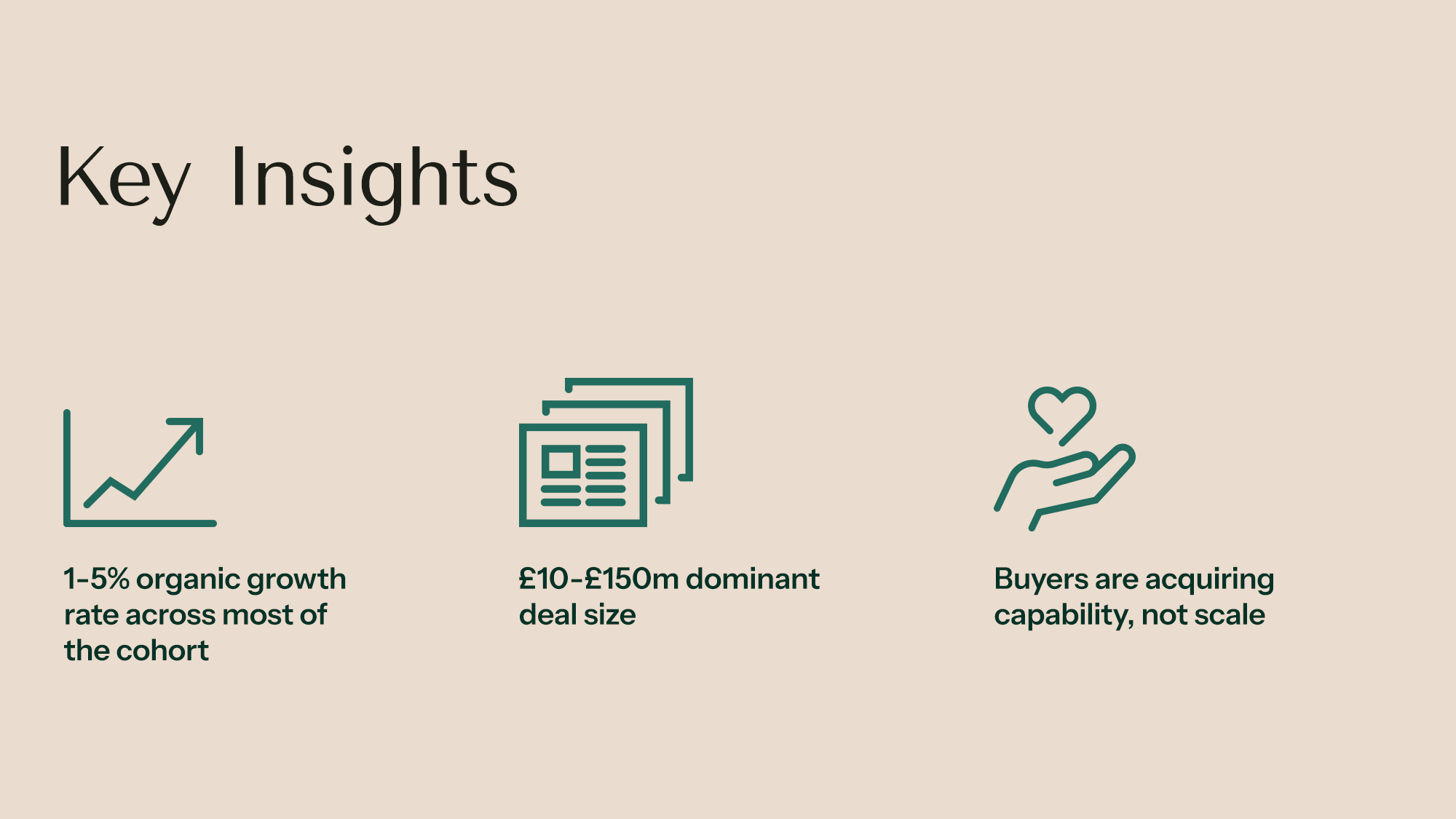
Most of the ten listed tech services buyers we analysed are growing at 1-5% organically, and are using M&A to accelerate beyond that.
Financial services is the standout vertical across the cohort, driven by AI-enabled transformation, regulatory modernisation and risk automation.
Buyers are acquiring for specific things behind the AI banner: platform IP, vertical depth, delivery geography, or specialist talent.
The dominant acquisition pattern across the cohort is targeted bolt-ons in the £10-150m range, not transformational megadeals.
The most sophisticated buyers in this sector are openly acknowledging in their own annual reports that AI may reduce demand for their core services.
Every year, the world's largest technology services companies publish their annual reports. Buried inside the financials, the acquisition notes and the strategic updates is something more useful than most market commentary: a direct, audited account of what these businesses are doing, what they are buying, and where they are placing their bets.
We took ten of them - Accenture, Capgemini, Cognizant, IBM, EPAM, Globant, Sopra Steria, Reply, Publicis Groupe and Stagwell - all listed, all December year-ends, all either pure-play system integrators or digital transformation consultancies, and ran them through a comparative analysis to identify the patterns that matter for founders of tech services businesses considering their exit options.
The Indian majors, TCS, Infosys, Wipro, HCLTech and LTIMindtree, are not included here. They operate on March year-ends and their FY2025 reports are not yet published; they will be covered in a companion piece later in 2026.
What follows are eight findings from that analysis, ordered from the least to the most surprising. If you already know the market well, the first few will confirm what you suspected. The later ones are worth reading carefully. They challenge assumptions about how buyers in this sector operate that could affect how you position your business and when you take it to market.

Organic growth is modest; M&A is doing the heavy lifting
Several of the largest names in tech services are growing at between 1% and 5% organically. IBM Consulting grew 0.4% in constant currency. Capgemini's underlying organic performance was flat before the WNS and Cloud4C deals landed. EPAM's 15.4% headline growth included 9.2 percentage points from its 2024 acquisitions of NEORIS and First Derivative.
There is pressure to show growth, and M&A is how these businesses are meeting that. Sustained acquisition appetite is good news for founders in this space who are considering their options.
Financial services is the standout vertical
Financial services grew faster than any other sector for the majority of these ten companies in 2025. EPAM's financial services revenues grew 41.8% in Europe. Cognizant named it a primary growth driver. Reply listed it as a key vertical. The catalyst is consistent across every report: financial services clients are investing heavily in AI-enabled transformation, regulatory modernisation and risk automation.
If your business serves financial services clients, or has demonstrable capability in capital markets, insurance or financial data, you are operating in the sector buyers are most actively chasing right now.
AI is the universal acquisition thesis
Every company in this cohort is acquiring to build AI capability. This will surprise nobody. What is worth noting is the scale and consistency of the commitment. Accenture completed 23 acquisitions in FY2025 at a combined cost of approximately $1.5bn, all framed around AI, cloud and industry-specific capability. Cognizant allocated roughly 50% of its free cash flow to acquisitions, with AI delivery at the centre of its stated rationale. IBM invested $8.3bn in R&D across the group.
AI has moved from strategic priority to the organising principle for capital deployment across the sector.
New pricing models are gaining traction
The shift away from time-and-materials billing has been talked about for years. The 2025 reports suggest it’s starting to happen in practice. Globant launched its AI Pods model in 2025, described as "a subscription-based delivery model for AI-powered services" providing clients with "scalable access to AI-enabled capabilities" through monthly, token-based subscriptions. Stagwell's Marketing Cloud, its SaaS and data product suite, grew 34% organically. IBM describes its consulting model as a deliberate shift toward "people plus software" to drive margin expansion.
The direction is consistent: buyers are building businesses that can scale without simply adding headcount. Where your revenue model sits on that spectrum is worth understanding before you go to market.

What buyers are purchasing behind the AI banner varies significantly
This is where the data starts to get more interesting. Every buyer says AI. But what they are buying to get there differs considerably.
Capgemini's WNS acquisition was about data infrastructure and process scale at volume. EPAM's NEORIS deal was about Latin American delivery geography. Cognizant's 3Cloud acquisition was about Microsoft Azure engineering capability. Reply's Red Scientific acquisition was about UK defence consulting. Accenture's 23 deals collectively targeted capability gaps across specific industry verticals.
‘AI-relevant’ is not a single buyer signal. Buyers are looking for specific things: platform IP, vertical depth, delivery geography, or specialist talent. A business that understands which of those it represents, and positions accordingly, is in a materially stronger place than one that leads with a generic digital transformation narrative.
Acquisitions are smaller and more targeted than the headlines suggest
The Capgemini/WNS deal dominated the sector news in 2025. At over $3.3bn it was Capgemini's largest acquisition since Altran in 2020, and it skews perception of what deal activity in this market looks like.
The reality across the rest of the cohort is different. Accenture's 23 acquisitions averaged roughly $65m each. Reply made two small bolt-on acquisitions. Globant acquired ADK Global for $21.7m. EPAM's one 2025 acquisition was $8.8m. The dominant pattern is targeted bolt-ons in the £10m to £150m range, adding specific capability or geography rather than transformational scale.
The assumption that buyers in this sector are only interested in larger businesses does not hold up in the data.
Intelligent Operations is being institutionalised as a distinct category
Most founders won't have encountered this term in the way the largest buyers are using it. What was previously called Business Process Outsourcing is being repositioned across the cohort as AI-powered Intelligent Operations: consulting-led, technology-driven, and framed as a high-value growth category rather than a cost-reduction play.
IBM restructured its entire consulting segment in 2025 around two categories, Strategy and Technology, and Intelligent Operations, with the latter growing faster. Capgemini's WNS deal was explicitly framed as establishing the group as a global leader in agentic AI-powered Intelligent Operations. Capgemini's Universal Registration Document describes the approach as moving "beyond traditional cost arbitrage to a consulting-led, tech-driven model, blending human capabilities with AI agents for seamless orchestration across processes."
If your business sits in managed services, business process transformation or operational consulting, the category your buyers are building into has a new name and a meaningfully higher valuation frame attached to it.
AI is simultaneously the growth driver and the existential threat
This is the finding that stands out most from the 2025 reports. The largest, most sophisticated acquirers in this sector are openly acknowledging in their own statutory filings that AI may reduce demand for their core services.
This is not buried in boilerplate risk language. EPAM's 2025 year-end reports state directly that AI innovations "may reduce the need for our services" and that clients "may continue to use AI-powered tools to create or modify software applications themselves, rather than purchasing our services." Reply's market commentary flags that if AI tools lift developer productivity enough, "the same transformation outcomes could be achieved with fewer external service hours, implying tighter long-term growth ceilings for traditional delivery models."
The companies navigating this most confidently are those with proprietary IP, platforms or methodologies that are difficult to replicate. The ones carrying the most uncertainty are those whose value proposition has historically been centred on headcount-based delivery at scale.
A business with repeatable IP, a defensible methodology, or a specialism that AI cannot easily replace becomes a more valuable asset to sell, and the buyers' own words confirm why.
What to take from this
The 2025 annual reports paint a picture of a sector investing heavily and moving fast, but doing so with more nuance than the headline AI narrative suggests.
Buyers are acquisitive, selective, and in many cases more interested in businesses of the size that founder-led companies in this space represent than the megadeal coverage implies.
Which vertical is hot and which buyer is most active matters less than understanding what buyers are building and where your business fits within it. The founders who will get the best outcomes from this market are the ones who understand what buyers are building behind the scenes, and can speak directly to where they fit within it.
If you want to understand where your business sits in this buyer landscape, we'd be glad to have that conversation. Schedule a consultation here.
