
UK Clinical Trial Regulations: What the Latest Reforms Mean for CRO M&A
Highlights:
The April 2026 clinical trial reforms have reversed a decade of lost ground on early-phase trial speed, and UK CROs with early-phase capacity are the primary M&A beneficiaries
ICH E6(R3) has raised the diligence bar. Operators with quality systems embedded in day-to-day practice will move through due diligence cleanly and protect their valuations
Closer UK/EU regulatory alignment has created a new premium for CROs that can operate across both jurisdictions, with strategic buyers increasingly looking to UK acquisitions as the foundation for cross-border platform plays
Therapeutic specialisation remains the dominant valuation signal, with oncology, rare disease, CNS, and cell and gene therapy commanding the strongest buyer appetite
Sponsor appetite was already building before the reforms took effect — Tura anticipates clearer differentiation in CRO performance through Q4 2026 and into 2027, with specialists pulling away from generalists

The April 2026 clinical trial reforms have changed what a well-positioned UK CRO looks like to a buyer. Regulatory readiness is now a diligence priority, and owners considering a sale need to understand how acquirers will assess it.
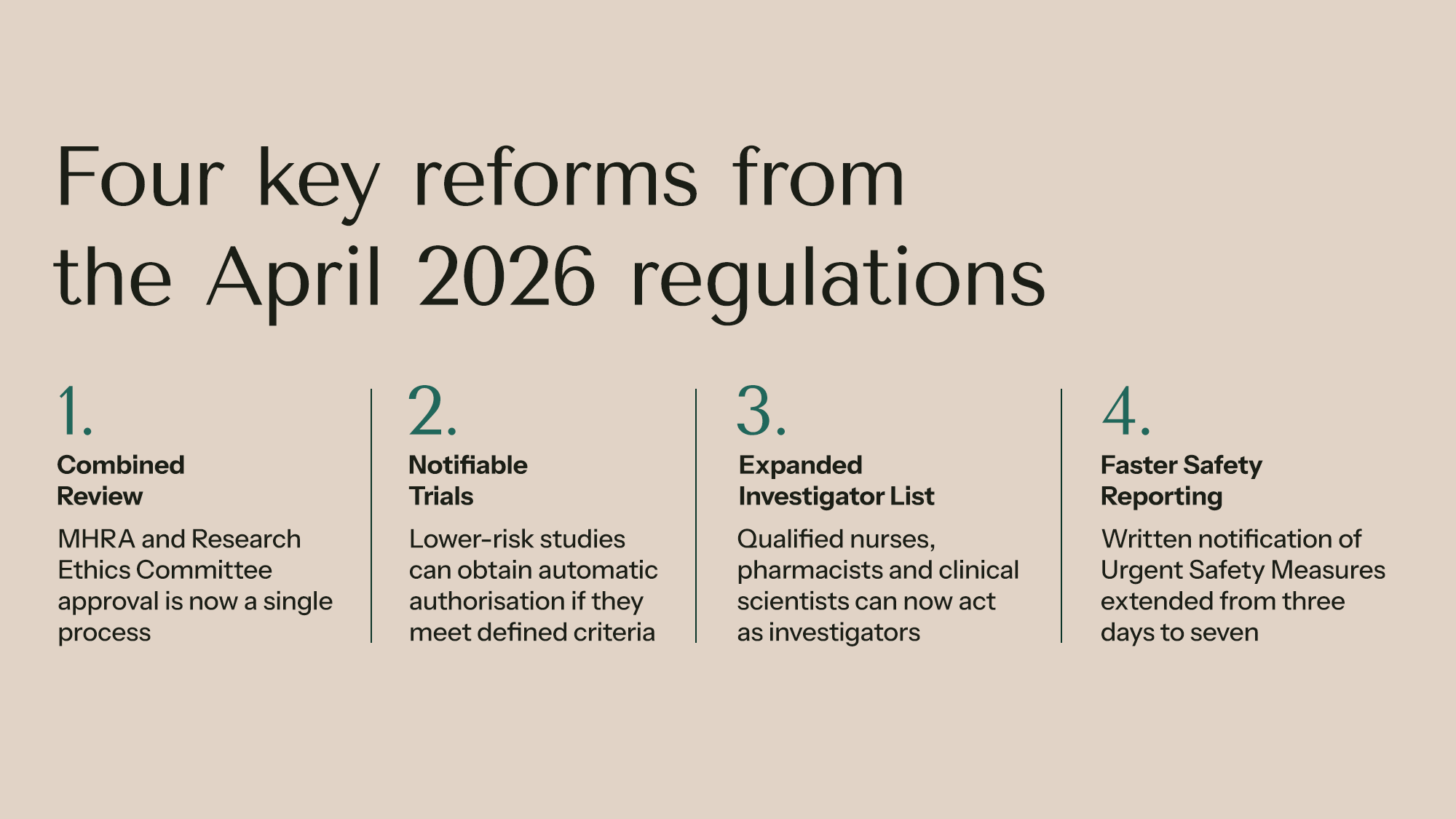
The Medicines for Human Use (Clinical Trials) (Amendment) Regulations 2025 came into force on 28 April 2026, and set out the most significant overhaul of UK clinical trials regulation in two decades. The reforms cut approval timelines and reduce the regulatory burden on lower-risk studies without weakening patient safety standards. Four changes have direct consequences for how CROs operate and how acquirers will assess them:
Combined Review by the MHRA and Research Ethics Committees is now a single legally mandated process
A notifiable trials route allows lower-risk studies to obtain automatic authorisation if they meet defined criteria, including trials of medicines already approved in the UK, EU, EEA or US
The list of who can act as an investigator has been widened beyond doctors, allowing appropriately trained nurses, pharmacists and clinical scientists to take that role
The deadline for written notification of Urgent Safety Measures has moved from three days to seven, aligning with European timeframes
The UK has shifted from a slow, fragmented venue with overlapping regulator and ethics review to one that can plausibly compete with Australia and Spain on early-phase speed, with knock-on consequences for the demand side of the CRO market.
Early-phase volume is coming back to the UK
Sponsor allocation of trial work follows three things: speed, cost, and regulatory predictability. For the last decade, the UK lost ground on the first, particularly in early-phase studies where slow start-up times were a recurring complaint. The introduction of a 14-day Phase 1 pathway and a 150-day overall target reverses that.
Phase 1 is the gateway to later-phase work. Sponsors who run their first-in-human studies in the UK tend to keep follow-on Phase 2 and Phase 3 work in the same network, particularly where investigator relationships and site activation history are already in place. Pulling early-phase volume into the UK pulls a multiple of downstream work behind it.
UK CROs with early-phase capacity are looking at a structural tailwind, not a cyclical one. Acquirers will read that as revenue growth with longevity behind it, which supports stronger valuations and more competitive buyer interest.
ICH E6(R3) has raised the bar on due diligence
The MHRA has implemented ICH E6(R3) alongside the regulatory reform. ICH E6(R3) is the latest international standard for how clinical trials must be run, shifting from a tick-box compliance model to one where CROs must demonstrate their active risk management across every stage of a trial. CROs with mature quality systems will find due diligence more straightforward than those whose SOPs, training records and data governance have lagged.
Sellers should be prepared for a tighter diligence environment. An organisation that cannot produce that documentation will face greater scrutiny from buyers, who may assume they are inheriting a compliance problem they’ll have to fix. Operators with quality systems embedded in day-to-day practice will find this environment works in their favour and reduces friction through diligence.
Cross-border capability is now a premium
A separate consequence of the reform is closer alignment with the EU Clinical Trials Regulation, which has been fully in force since January 2025. The UK framework is not identical to the EU’s, but it is now meaningfully closer than it was, particularly on transparency obligations and safety reporting. That strengthens the commercial logic for operating across both jurisdictions.
Sponsors running multi-country trials want partners who can manage Combined Review submissions in the UK and Clinical Trials Information System (CTIS) submissions in the EU without duplicating effort or fragmenting their data systems. That capability is hard to assemble organically, which is part of why buyer appetite for UK/EU integrated platforms should build over the next 12 to 18 months.
The reforms create a new acquisition rationale for buyers with cross-border ambitions. A well-positioned UK specialist now operates to a framework that is meaningfully compatible with EU submissions, which means any buyer looking to build a UK/EU platform can use a UK acquisition as the foundation rather than an afterthought. The cost and complexity of adding EU capability on top of a compliant UK base is materially lower than it was before April 2026, and that changes how a strategic buyer models the expansion story.

Specialist CROs still command the highest valuations
The therapeutic specialisation thesis that has been driving CRO valuation through 2025 and 2026 remains the dominant signal, and the UK reforms reinforce rather than displace it.
Oncology, rare disease, central nervous system, and cell and gene therapy are the segments where clinical complexity is highest, and specialist CRO capabilities are hardest to replicate. CROs operating in those areas with a UK footprint should benefit from the regulatory change on top of the underlying therapeutic tailwind.
Deal flow outlook for 2026-2027
Early data suggests that sponsor appetite for UK trials was already building before April. MHRA application volumes rose 9% in 2025 ahead of the regulatory change taking effect. That demand will find its way into CRO revenues with a lag of six to 12 months. By Q4 2026 and into 2027, Tura anticipates a clearer differentiation in CRO performance, with UK and UK/EU specialists pulling away from generalists on growth and pipeline visibility.
Specialist CROs that have already done the work on E6(R3) readiness, and that can document the therapeutic specialisation, site networks and repeat sponsor relationships behind their positioning, should find current market conditions favourable. Buyer conditions are increasingly competitive, with both strategic and financial acquirers active in the space.
The April 2026 reforms have shifted what buyers are looking for in a UK CRO acquisition. If you want to understand where your business stands, speak to Tura's Healthcare & Life Sciences team.
