
Highlights:
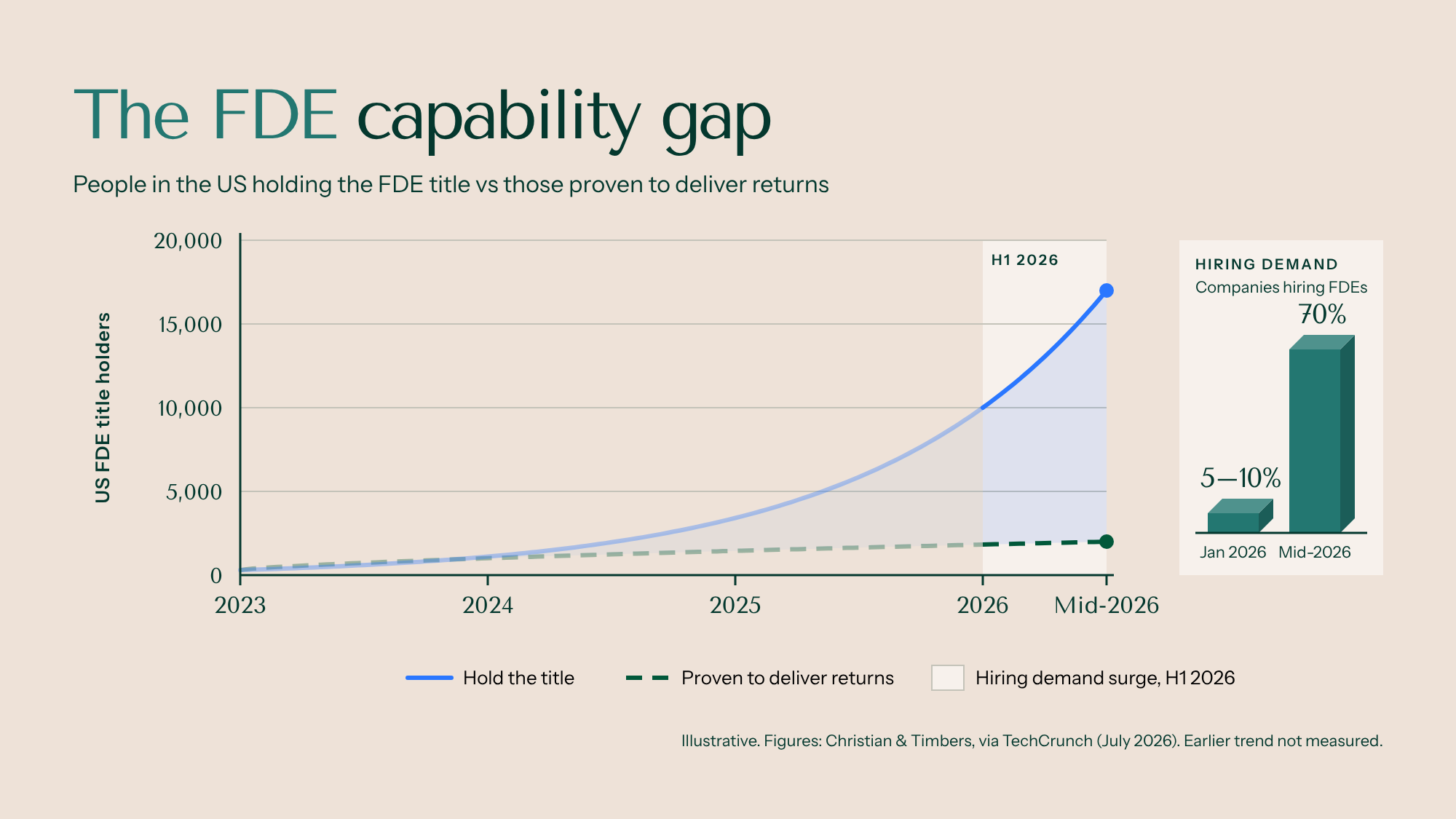
Demand for FDEs has surged in 2026. By the end of Q2, 70% of businesses were planning to hire them, up from 5–10% at the start of the year.
Around 17,000 people in the US hold the FDE title, yet only about 2,000 have repeatedly turned deployments into documented business value. Renamed roles and basic training appear to be filling the gap.
Palantir’s original model paired engineers with deployment strategists who questioned what should be built. Without someone owning that question, FDEs may struggle to deliver consistent ROI.
Buyers will test any FDE claim in due diligence. A label without the capability behind it risks undermining credibility and valuation.
Applied as designed, the FDE model can add real value, but its worth to a buyer depends on evidenced capability throughout the business.
The FDE model has become one of the most in-demand approaches in enterprise AI. FDEs (Forward Deployed Engineers) are technical specialists who work inside a client’s organisation, building and deploying AI around the problems the business faces day to day. Under the model an AI provider or consultancy embeds these engineers with the client for the length of a project, with the aim of making sure the AI the business has paid for produces measurable results.
As demand has surged, tech services firms have moved quickly to claim their share. As a result, much of what is being sold under the label of the ‘FDE model’ looks like existing capability renamed, rather than new AI expertise.
Under buyer scrutiny, the gap between the label and the capability behind it is hard to hide. Adopting the FDE model label puts tech services businesses at the centre of the AI opportunity, but while it might be tempting to a tech services founder, buyers will look past it to inspect what sits underneath. Only defensible capability running throughout a business will hold value when it comes to negotiations.
What happens when demand outruns capability
Demand for FDEs has grown at a pace that makes the model hard for any tech services business to ignore. At the beginning of 2026 only 5–10% of companies were planning to hire FDEs. By the end of Q2, that figure had reached 70%, with the largest consulting and services firms reporting a need to grow their FDE headcount tenfold. Major players are already reaching for a slice of the pie. Accenture has launched FDE practices with Microsoft, ServiceNow, and Google Cloud, while OpenAI and Anthropic have also launched services ventures around the role.
Executive search firm Christian & Timbers estimates that around 17,000 people in the US now hold the ‘FDE’ title, yet only about 2,000 have repeatedly turned deployments into documented business value. That shortage is built into the technology itself, as generative AI only entered mainstream enterprise use in late 2022. There is no such thing as a developer with ten years of experience deploying generative AI, which leaves many title-holders without a proven track record in generative AI, in a market where demand is climbing.
Much of the FDE capability now on offer is existing talent under a new title. Solutions engineers, implementation consultants and technical account managers have embedded with clients for years. Many of them are highly capable in their own right, but renaming the role creates the temptation to add a premium without changing what is delivered. Large firms have often grown by putting junior staff on digital transformation projects, and the FDE model is open to the same approach. With so little deep expertise in the market, it is easier to label someone an ‘experienced’ FDE after only basic training.
Even the businesses built around the model are investing heavily to close the gap. Google is set to train up to 1,000 FDEs for Accenture’s new unit, which draws on its existing bench of nearly 50,000 Google Cloud-skilled professionals. Chris Taylor, chief executive of Ode, the Anthropic, Blackstone and Hellman & Friedman services venture, put it this way: “Many FDEs are well equipped to help you roll Claude Code out to your workforce. Very few are capable of building your flagship AI product feature.”

Engineering alone doesn’t deliver ROI
A lack of experience is only part of the problem, as even firms with strong engineers can fall short if nobody on the engagement owns the question of what should be built.
Palantir pioneered the model well before generative AI, embedding engineers to deploy its data software inside client organisations. Its engineers (known internally as Deltas) worked alongside deployment strategists (known as Echos). Echos lean towards product management, going on site to understand the critical questions a customer needs answers to. Deltas on the other hand are more technical. In practice the line between the two blurs, as Palantir itself acknowledges, but the principle holds: someone on the engagement owns the ‘why’.
The pairing matters to the model because the two roles fulfil different roles. An engineer placed inside a client’s business will solve the problem in front of them, but may be less likely to explore why that problem matters, whether it's the right one to solve, or how solving it will move a number the client cares about. That questioning is what turns a deployment into a return, and without someone in a product management role to lead it, FDEs may struggle to deliver consistent ROI. The largest players recognise this, with Accenture’s Google Cloud unit placing industry and process specialists alongside its engineers. Offering engineers with no one owning that question leaves them solely responsible for returns, even though the question sits outside their usual brief. It is also one of the first gaps an acquirer is likely to discover when assessing a tech services business positioning itself under the FDE umbrella.
What M&A buyers will look for
A capability that cannot deliver will not survive due diligence, whatever label it carries. As our recent look at IT staffing M&A noted, relabelled revenue is easily identified under scrutiny and damages credibility with the buyer. Delivery models face the same test. Buyers are paying for real delivery capability: OpenAI’s purchase of Tomoro (May 2026) and Accenture’s of Faculty (Jan 2026) are recent examples.
A tech services business can describe its delivery as an FDE model if the capability behind it supports the claim. What holds its value is capability that runs throughout the business: people who frame client problems working alongside those who build the solutions, outcomes that can be evidenced with numbers, delivery experience drawn from live client work, and client relationships that sit with the business as a whole.
A few questions help founders to test where their business stands against that standard:
Could you show a buyer measurable outcomes from recent client engagements?
Who on each engagement is responsible for questioning whether the work will deliver a return?
How much of your team’s AI delivery experience comes from live client work?
If you dropped the FDE title tomorrow, would clients notice any changes in what you deliver?
Would your key client relationships remain if your most senior technologists left?

What makes the FDE model worth backing
The FDE model was built to solve a real problem. Businesses investing in AI need that investment to produce results, and embedding people within a client’s business to make that happen is a sound approach. But demand currently exceeds supply and the experience needed to meet it. In generative AI, which only entered mainstream use in late 2022, the gap is being filled with renamed roles and basic-level training. Much of what is sold under the FDE label looks like a rebrand of existing capability rather than new expertise.
The problem deepens where the model is stripped back to engineering alone. The original version worked because engineers paired with people whose role was to question what should be built and how it would produce a return. Without that questioning, the promise of ROI rests on people whose brief doesn’t usually include asking how it will be achieved, and the outcomes the model is known for become far harder to reach.
The appeal of the label to tech services founders is understandable, as it positions a business at the centre of the AI opportunity. Buyers will test any FDE claim in due diligence by looking for the evidence behind it. They’ll be looking at who frames client problems, what results the work has delivered, and whether the team’s experience comes from live client engagements. A business that can answer those questions confidently has a strong story to tell, whatever it calls its delivery model. A business relying on a title alone can undermine its credibility with the buyer, and its valuation with it.
Applied as it was designed with strategic thinking guiding the engineering, the FDE model can add real value to a tech services business. Founders who build that capability, and can evidence successful outcomes, will be more likely to find buyers that are interested in acquisition.
If you want to understand how buyers will evaluate the capability behind your delivery models, get in touch with Tura’s expert advisors.