
IT Staffing Is Moving Up the Value Chain and M&A Buyers Are Following
Highlights:
The IT staffing market is beginning to stabilise, but M&A activity has yet to see a broad-based recovery and remains highly selective.
The market is moving along a spectrum from replaceable revenue to defensible revenue, and buyers are paying premiums for the latter.
Founders waiting for 2021 valuations to return risk missing that the market has structurally changed. Moving into niches that buyers are paying a premium for is considerably more actionable than waiting for the perfect quarter to sell.
Where specialist positioning, defensible delivery capability and client relationships the business owns are already in place, the current environment may be considerably more favourable than recent headlines suggest.
After almost three years of difficult staffing conditions, the operating market is beginning to show signs of recovery. M&A has not followed in a straight line. According to PitchBook, Q1 delivered an encouraging increase in activity from recent years, with 54 US deals and 21 UK deals recorded, but overall transaction volumes fell back to 36 and 17, respectively, in Q2. Broader transaction data suggests activity remains well below the highs of 2021-22, where US deal volumes reached over 200 transactions each year.
Earnouts and deferred consideration are increasingly being used to bridge valuation gaps, and PE add-on activity remains subdued. The UK market has been cautious, with sector M&A volumes falling around 10% in 2025 to 97 transactions, and the broader recruitment market contracting in value for the year. The expectation entering 2026 was stabilisation rather than a return to previous activity levels.
The market has improved enough to transact, but it hasn’t signalled a return to 2021, when almost any growing IT staffing business could attract aggressive pricing. What the current data reflects is a buyer community that has become considerably more selective about what it wants. The more important change is not how many staffing businesses buyers are acquiring, but what they are choosing to buy.

The market is moving
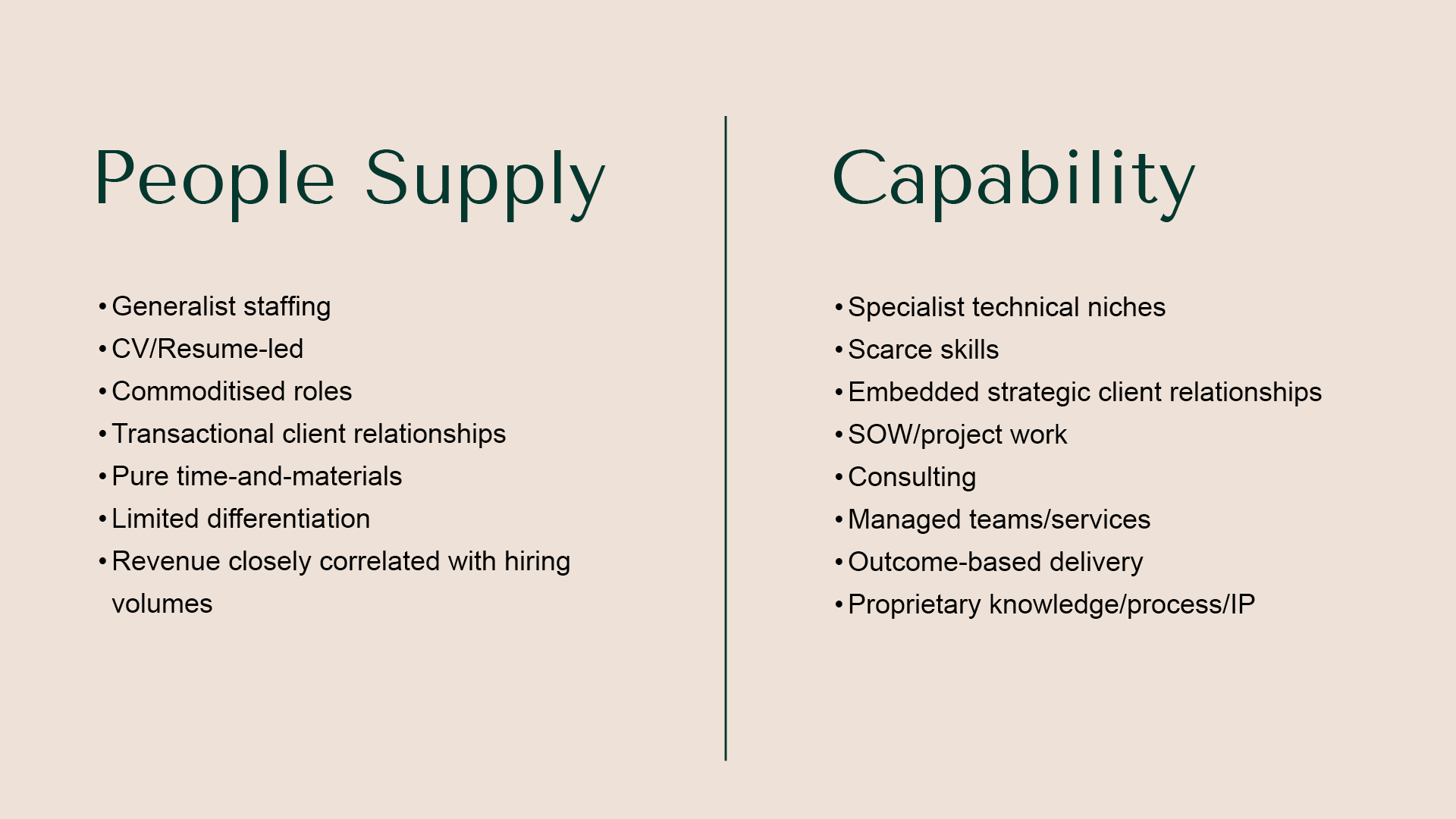
IT staffing is moving up the value chain from transactional talent supply towards specialist, tech-enabled and solutions-led models, and that shift is playing out across a spectrum. Where a business sits is beginning to determine its M&A prospects more than sector-wide deal volumes.
At one end of the spectrum sit people supply businesses; generalist staffing, CV-led recruitment, commoditised roles, transactional client relationships, and pure time-and-materials delivery. These businesses have revenue that closely tracks hiring volumes and has to be rebuilt with each new placement cycle.
At the other end sits capability; specialist technical niches, scarce skills, embedded client relationships, SOW and project delivery, consulting capability, and outcome-based work - businesses that own something a buyer can’t easily replicate or build organically.
A traditional recruiter supplying largely undifferentiated contingent talent doesn’t participate in the same M&A market as a specialist technology talent business with genuine delivery or SOW capability. The former is finding that buyers have more alternatives, more questions and considerably more negotiating leverage, while the latter is attracting strategic interest and better valuations. Buyers will see through cosmetic repositioning from one end of the spectrum to the other, as staffing revenue relabeled as consulting is easily identified in diligence and will damage credibility rather than building it.
Specialist businesses are attracting buyer interest
The reason buyers are gravitating towards the specialist end of the market are economic, and they’re compounding.
Revenue generated from delivering against an ongoing project or managed capability is harder to displace than revenue from repeatedly filling individual roles and doesn’t necessarily disappear the moment a client pauses hiring. That defensibility is attractive to buyers, as is the fact that what they’re buying isn’t something they could easily build themselves. Recreating a specialist market position, a deep talent community in a scarce technical discipline, or embedded client relationships where a business is genuinely trusted to deliver outcomes takes years. Buying it is faster and, in some cases, the only realistic route.
Specialist businesses also tend to command better economics than those competing on contingent labour supply. A strategic buyer with an existing customer base may be able to deploy an acquired specialist capability across hundreds of client relationships, creating value the target’s standalone EBITDA alone wouldn’t suggest.
AI is also likely to widen the valuation gap by enabling staffing platforms to become more scalable and technology led. In the near-term, AI is creating significant demand for scarce talent and project delivery around data infrastructure, cloud modernisation, governance, application modernisation and implementation. In the long-term, however, technology that makes talent identification, matching, initial screening, scheduling and workflows easier compromises the defensibility of a business whose primary value is finding available candidates. Buyers are therefore increasingly rewarding defensibility. Scarce talent, embedded client access, contracted gross profit, genuine delivery capability and consulting expertise all contribute to it, but the underlying question is the same: how hard is this business to displace?

What buyers appear willing to pay for
Understanding what earns a premium in this market is more useful than tracking where EBITDA multiples are trading in aggregate, because the two are increasingly diverging depending on the type of business in question.
The starting point is specialisation. Cyber, cloud, AI infrastructure, data and engineering disciplines are inherently harder to replicate than broad IT recruitment coverage, and buyers pay for genuine scarcity. That scarcity becomes more valuable still when it comes with forward revenue visibility such as committed project work or managed service agreements that give an acquirer confidence in what they are buying.
Client relationships sit at the heart of both of those points. Deep, long-standing relationships are an asset, but the nature of those relationships matters as much as their depth. Heavy dependence on one or two clients is a risk buyers price carefully, because concentration that looks like strength in normal trading can become a serious diligence issue under scrutiny. Related to this is the question of who holds those relationships. If every material client contact belongs personally to the founder, a buyer isn’t acquiring an institution, they’re acquiring a dependency. That distinction will shape both valuation and deal structure.
Underpinning all of this is the question of growth. Buyers need a credible picture of where the next leg comes from – sector expansion, geographic reach, adjacent capability, cross-sell potential, and logo expansion. A business that is well-positioned today but cannot articulate where it goes in the hands of an acquirer will find that gap reflected in how buyers engage and, ultimately, what they offer.
The valuation trap
Many founders spent 2023 to 2025 waiting for trading conditions and valuation multiples to recover to where they were in 2021, fearing selling at the wrong point in the cycle. But there’s a bigger risk - waiting for a valuation environment that may no longer apply to your business model.
The M&A market is changing, and if buyer preference continues moving towards specialist, solutions-led, and defensible capability, passively waiting for market multiples to come back won’t make a business more valuable. In some scenarios it makes it less so, as the gap between what the market rewards and what the business can offer continues to widen. Instead, founders should be spending time moving into niches that buyers are paying a premium for. That conversation - about positioning, capability and client relationships - is considerably more actionable than trying to predict the perfect quarter to sell. It is also what creates the competitive tension that commands a premium valuation.

Which M&A market are you actually in?
Sector-wide transaction statistics will tell you relatively little about your own position. Instead, ask yourself these seven questions.
Could a competitor credibly replicate what you do within 12 months?
Are clients buying people from you, or capability?
How much of your revenue would continue without constantly generating new placements?
How much of next year’s revenue is already visible from existing clients and contracted work?
Are you a genuine specialist? (Recruiting technology professionals broadly is not a specialism, but owning a talent community and delivery track record in a defined discipline is.)
What could an acquirer sell through you, or you through them, that they cannot do today?
If your founder stepped back for six months, would the major clients remain?
The answers to these questions will tell you considerably more about likely buyer appetite than any set of quarterly transaction statistics.
Where this leaves the market
IT staffing M&A is showing signs of opening again, and for the right businesses the pipeline is improving. The businesses that are attracting attention in 2026 are those that combine talent access with genuine expertise, specialist positioning and client relationships the business owns rather than individuals. Where those characteristics are already present, the current environment may be considerably more favourable than the gloomy staffing headlines of the last couple of years would suggest. Where they’re not, waiting for the cycle to improve is unlikely to close the gap. The more productive stance is to ask the questions of what can be built in the next 12 to 24 months that changes what a buyer would be acquiring?
If you lead an IT staffing or technology talent business and are considering your options, Tura Advisory works with founder-led businesses throughout every stage of the process. Get in touch.

