
Inside Accenture's Tech Services Acquisitions: Reading The Market Through M&A
Highlights:
Accenture has completed 306 acquisitions since 2016, making its M&A activity an interesting indicator of where strategic value and buyer interest is moving in the tech services space.
The market is moving towards a two-layer model: foundational infrastructure that makes AI adoption possible at enterprise scale, and AI-native capability built on top.
Even in an AI-heavy market, the digital core remains strategically valuable - buyers are not only chasing AI-native firms.
The most attractive businesses have a sharp specialism, real delivery credibility, and a clear connection to a major client priority.
Accenture is the most active buyer in the tech services industry right now. Since 2016, the firm has completed 306 acquisitions. What makes this notable is not just the number, but the approach. Accenture's acquisitions are not episodic, but a sustained, programmatic part of how it builds capability. At that volume and consistency, the pattern of what Accenture buys functions almost as a live map of where the giant believes strategic value is concentrating.
Read together, the acquisitions suggest the market is consolidating around two distinct layers. At a foundational level, there’s continued and significant demand for services that make AI adoption possible inside real enterprises: cloud infrastructure, managed services, data engineering, and increasingly deeper technical engineering tied to the hardware and infrastructure that powers AI at scale. More recently, trends around AI adoption have been driving M&A, and a new level has developed around the growing demand for AI-native capability: strategy, safety, decisioning, agentic workflows, and platform-specific deployment. Accenture is investing deliberately in both of these layers, and its recent acquisitions show exactly how.
In this article, we’ll take a look at five deals, spanning January 2024 to March 2026, to illustrate how that two-layer logic has played out in practice, and what it means for founders thinking about where value is being created in this market.
A machine built for capability, not scale
Before turning to the individual deals, it’s worth establishing what kind of buyer Accenture is, because the acquisition profile shapes how you read the decisions. Using data from Pitchbook, Tura's research team has analysed Accenture's acquisition activity across the past decade to identify the patterns that matter most.
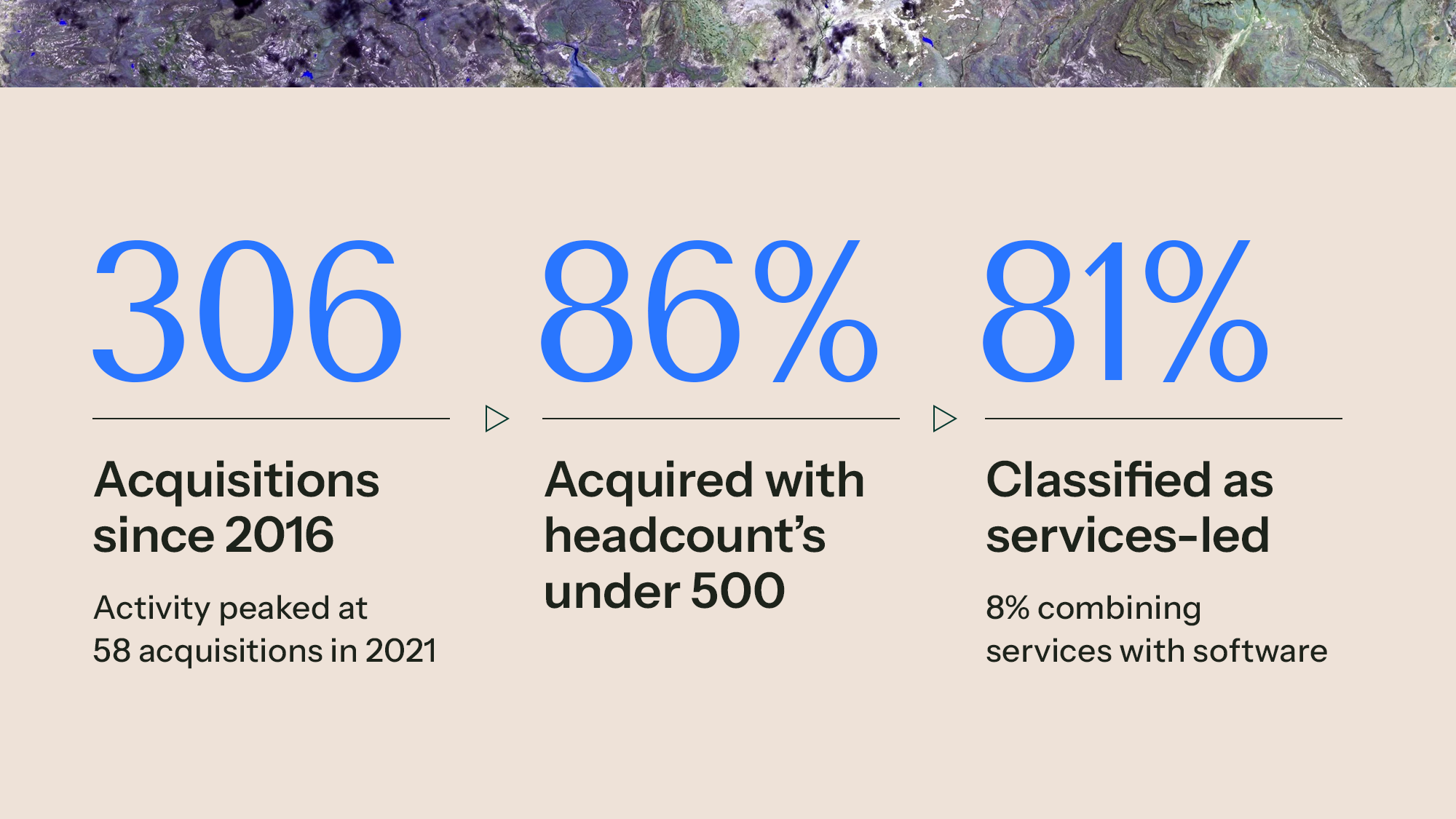
Accenture's approach is programmatic rather than episodic. Activity peaked at 58 acquisitions in 2021 and has remained elevated since, with 36 deals completed in 2024. The target profile is equally consistent. Where headcount is disclosed, the median acquisition is a firm of around 166 people, with more than 86% of targets below 500 employees. Accenture is buying focused teams with depth of capability, senior talent and client credibility, integrating those assets quickly into a global platform. The services orientation reinforces this: 81% of acquisitions are classified as services-led, with a further 18% combining services with software.
The composition of those acquisitions has also shifted significantly in the past decade. AI-related deals have nearly doubled as a share of activity since 2016. Industry and engineering capability has risen from just under 20% to nearly 39% of all acquisitions. Marketing and customer experience, once a major focus, has fallen from 35% to just 19%. Accenture has systematically redirected capital away from broad front-end digital work and towards the deeper, more technical capability that defines both layers of the market it is building towards.
Navisite: The digital core still matters
Navisite, completed in January 2024, is a reminder that even in an AI-heavy market, the digital core still matters. Accenture acquired the digital transformation and managed services provider to "bolster and scale its application and infrastructure managed services capabilities to help clients modernise their IT for the AI era," adding approximately 1,500 people to its infrastructure engineering practice, including more than 400 cloud engineers holding over 2,000 certifications.
The deal suggests Accenture still sees significant value in the less glamorous but essential part of the market: cloud, infrastructure, applications and managed services. That is what enables AI adoption at enterprise scale. Accenture is effectively buying both the new AI layer and the plumbing underneath it.
Founders should not assume that only AI-native firms are attractive to buyers. Businesses with sticky revenue, deep customer relationships and a role in the client's operating backbone can still be highly strategic — particularly if that work connects credibly to AI readiness.

Cientra: Going deeper into the engineering stack
Cientra, completed in July 2024, broadens the picture beyond software consulting into silicon design and engineering services. Accenture's Group Chief Executive for Technology, Karthik Narain, was direct about the rationale: "Everything from data centre expansion to cloud computing, wireless technologies, edge computing and the proliferation of AI are driving demand for next-generation silicon products. Our acquisition of Cientra is our latest move to expand our silicon design and engineering capabilities."
The deal shows Accenture is not viewing tech services narrowly. It’s moving deeper into the engineering stack underneath AI and digital infrastructure, including embedded systems and custom silicon capabilities. The opportunity is no longer just in apps and cloud migration - it extends into the technical layers that power AI at scale.
For founders, Cientra is evidence that highly technical niches can be very strategic when they sit close to a major spend wave. You do not need to be large if you are hard to replace and tied to a structural growth theme. Differentiated engineering capability can matter considerably more than a broad digital transformation offer.
NeuraFlash: Owning a lane in a high-growth ecosystem
Announced in August 2025 and closed in September, NeuraFlash is a Salesforce and generative AI consulting company specialising in agentic solutions for sales, service and field service operations. It had delivered more than 1,000 successful implementations for over 400 customers globally, building deep Agentforce implementation experience at the precise moment that product was becoming a priority for enterprise clients. Accenture described the deal as strengthening its Salesforce and agentic AI capabilities while extending its reach into the mid-market globally.
The acquisition signals that Accenture is prioritising repeatable, commercial AI deployment, not just bespoke strategy work. It wants firms that can turn AI demand into scaled implementation revenue inside platforms clients already use, particularly where there is managed services potential and mid-market reach.
The most valuable position in a major enterprise ecosystem is often not the broadest one. There is also growing uncertainty around how major enterprise software stacks will evolve, and what that means for the firms built around them. NeuraFlash understood this early. Its value was not simply that it was a Salesforce specialist, but that it had identified and positioned around Agentforce specifically, ahead of the broader market recognising its significance. Being the best at a specific, high-growth combination (platform expertise, AI delivery and a proven implementation track record) is easier to position, easier to scale, and easier for a strategic buyer to plug into a global client base.
Faculty: Buying a point of view on trusted AI
Announced in January 2026 and completed in March, Faculty is one of Europe's leading applied AI companies, with services spanning AI strategy, AI safety, and the design, build and implementation of high-performance AI systems. Its work sits at the harder, more consequential end of AI deployment, illustrated by projects such as the NHS Early Warning System built during the COVID-19 pandemic.
With the acquisition completed, Faculty's CEO and co-founder Dr. Marc Warner assumed the role of Accenture's Chief Technology Officer. Julie Sweet, Accenture Chair and CEO, said: "Now that Faculty is part of Accenture, we will further advance our strategy to be our clients' reinvention partner of choice and lead in the safe, widespread adoption of AI."
This example is not just Accenture buying more AI delivery capacity. It suggests Accenture wants to move further up the value chain - not only implementing AI tools, but advising clients on trusted AI, governance, safety and decision systems embedded in core operations. It also shows Accenture treats senior technical leadership and genuine AI credibility as scarce assets worth acquiring rather than building organically.
Faculty’s acquisition signals where the real premium sits in the AI market. Buyers are paying up for firms that combine real technical depth, a clear point of view, and relevance to board-level AI spend. Positioning a business as AI-capable is now a baseline. The more valuable and more acquirable position is being trusted on the difficult parts - safety, deployment, mission-critical use cases and measurable outcomes.

Ookla: The layer beneath both layers
Announced in March 2026, Ookla is best known for Speedtest but operates a broader portfolio of network intelligence and connectivity analytics products, including Downdetector, Ekahau and RootMetrics, capturing more than 250 million consumer-initiated tests per month. As Julie Sweet stated at the time of the announcement: "Without the ability to measure performance, organisations cannot optimise experience, revenue, or security."
Network data is no longer just a concern for the telecoms industry. As AI scales, the insights captured at the network, device and application layers are becoming valuable across every sector, from fraud prevention in banking to smart home analytics in utilities and traffic optimisation in retail. Accenture is acquiring Ookla not just for its telecoms client base, but because network intelligence is becoming a cross-sector data asset in an AI-powered world.
For founders, Ookla is a reminder that strategic value isn’t always obvious. Data assets that appear adjacent to the mainstream can become core strategic infrastructure as AI adoption deepens. Proprietary data at scale, particularly where it is difficult to replicate, is increasingly the kind of scarce asset that a major acquirer will move to secure.
What the pattern reveals
These five deals are not the whole story, but they are among the most telling examples in recent years. Taken together, they point to a market moving towards a two-layer model. At one level, there’s intense demand for AI-native capability - strategy, safety, decisioning, agentic workflows and platform-specific deployment. At the other, there’s still heavy demand for the foundational services that make AI usable in real enterprises: cloud infrastructure, managed services, data engineering and the engineering layers that power AI at scale.
Another theme running across all five deals is that Accenture is not buying scale for its own sake. These acquisitions are about scarce expertise in areas where client demand is rising fast. The most attractive firms tend to share certain characteristics: a sharp specialism, real delivery credibility, and a clear link to a major client priority. Buyers like Accenture are rewarding firms that can help clients adopt AI safely, deploy it practically, or build the technical foundations that make it work.
For founders in tech services, the median acquisition target here employs 166 people. Scale is not the qualifier, and these five deals make clear what is.
Whether you are preparing for a sale or thinking about how your business is positioned for the future, Tura's team works with founders in tech services at every stage of that process. Get in touch to start the conversation.
